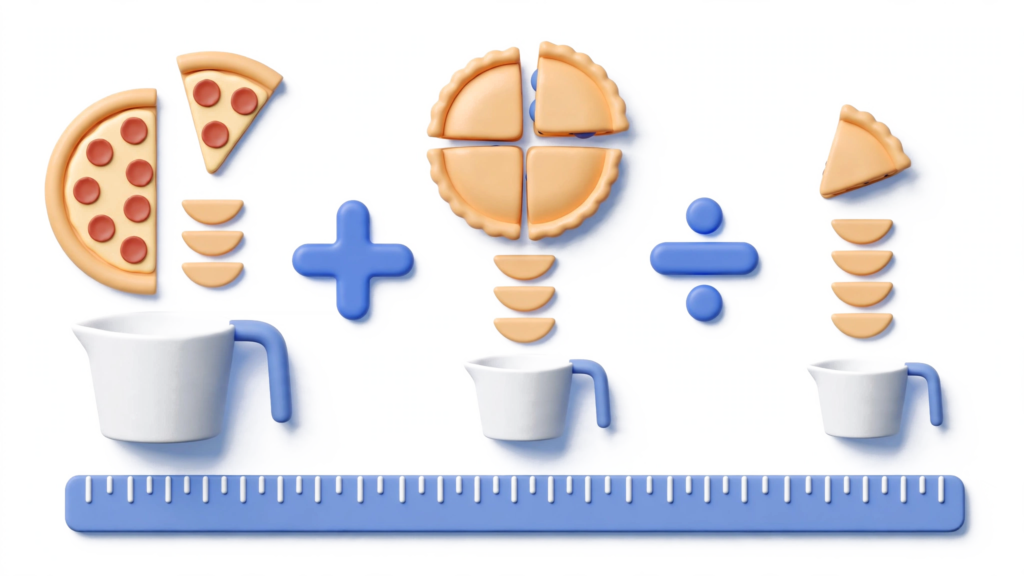
Add, subtract, multiply or divide two fractions.
How to Use the Fraction Calculator
Fractions are one of those things most of us learned in school and then quietly forgot. Then a recipe calls for 2/3 cup and you only want to make half, or a woodworking plan asks you to add 5/8 inch to 1 3/4 inches, and suddenly you need them again. This fraction calculator adds, subtracts, multiplies and divides two fractions, simplifies the answer, and shows it as a mixed number and a decimal too.
- Enter the numerator (top number) and denominator (bottom number) of your first fraction.
- Pick an operation: add, subtract, multiply or divide.
- Enter the numerator and denominator of the second fraction.
- The simplified answer appears instantly, plus the mixed number (if there is one), the decimal value and the unsimplified result.
For a whole number, use 1 as the denominator. So 3 becomes 3/1. For mixed numbers like 2 1/2, convert to an improper fraction first (5/2). Our mixed number to improper fraction calculator can do that in one step.
Fraction Basics in Two Minutes
A fraction shows part of a whole. The denominator tells you how many equal pieces the whole is split into, and the numerator tells you how many of those pieces you have. In 3/8, the pizza is cut into 8 slices and you have 3 of them.
- Proper fraction – the top is smaller than the bottom, like 3/4.
- Improper fraction – the top is equal to or bigger than the bottom, like 9/4.
- Mixed number – a whole number plus a fraction, like 2 1/4 (the same value as 9/4).
- Equivalent fractions – different-looking fractions with the same value, like 1/2, 2/4 and 50/100.
How the Fraction Calculator Works: The Four Rules
Adding fractions
You can only add fractions that share a denominator. If they don't, rewrite them so they do. The calculator uses the formula a/b + c/d = (a×d + c×b) ÷ (b×d), then simplifies. Example: 3/4 + 2/5 = (15 + 8)/20 = 23/20, or 1 3/20 as a mixed number.
Subtracting fractions
Same idea, but subtract the numerators: a/b − c/d = (a×d − c×b) ÷ (b×d). Example: 5/6 − 1/4 = (20 − 6)/24 = 14/24, which simplifies to 7/12.
Multiplying fractions
The easiest one. Multiply straight across: a/b × c/d = (a×c) ÷ (b×d). Example: 2/3 × 3/4 = 6/12 = 1/2.
Dividing fractions
Flip the second fraction and multiply. Teachers often say "keep, change, flip." a/b ÷ c/d = (a×d) ÷ (b×c). Example: 3/4 ÷ 1/8 = 3/4 × 8/1 = 24/4 = 6. In other words, six 1/8-cup scoops fill 3/4 of a cup.
Fraction Calculation Examples
| Problem |
Working |
Simplified answer |
Decimal |
| 1/2 + 1/3 | (3 + 2)/6 | 5/6 | 0.8333 |
| 7/8 − 1/2 | (14 − 8)/16 = 6/16 | 3/8 | 0.375 |
| 3/5 × 5/9 | 15/45 | 1/3 | 0.3333 |
| 2/3 ÷ 4/9 | 2/3 × 9/4 = 18/12 | 3/2 (1 1/2) | 1.5 |
| 7/4 + 5/8 (1 3/4 + 5/8 inch) | (56 + 20)/32 = 76/32 | 19/8 (2 3/8) | 2.375 |
| 2/3 × 1/2 (halving a recipe) | 2/6 | 1/3 | 0.3333 |
Where You'll Use Fractions in Real Life
- Cooking and baking. US recipes are full of fractions: 3/4 cup of sugar, 1/3 cup of oil, 1/2 teaspoon of salt. Scaling a recipe up or down means multiplying every fraction by the same amount.
- Woodworking and DIY. Tape measures in the US and Canada are marked in inches split into halves, quarters, eighths and sixteenths. Adding 2 5/16 to 1 7/8 is a typical job for a fraction calculator.
- Money and time. A quarter of an hour, half a year's salary, a third of the rent. We think in fractions more than we realize.
- Homework. Fraction operations are a big part of grades 4 through 7 math, and parents helping with homework often appreciate a quick way to check answers. The calculator shows the unsimplified result, too, so students can compare it with their own working.
Tips for Working With Fractions
- Simplify at the end. The calculator always reduces the answer to lowest terms, but if you work by hand it is easier to simplify once at the end than at every step.
- Cancel before multiplying. In 4/9 × 3/8, the 4 and 8 share a factor of 4, and the 3 and 9 share a factor of 3. Cancel first and you get 1/3 × 1/2 = 1/6, with smaller numbers to handle.
- Watch your signs. Put a negative sign on the numerator only. The calculator handles negative fractions correctly.
- Never divide by zero. A denominator of 0 is undefined, and dividing by a fraction equal to zero is impossible.
Finding the Least Common Denominator
The calculator multiplies the two denominators together to get a common one, then simplifies at the end. That always works, but when you are working by hand, the least common denominator (LCD) keeps the numbers smaller. The LCD is the smallest number that both denominators divide into evenly. Take 5/12 + 7/18. Multiplying the denominators gives 216, which is clumsy. The LCD is 36, because 12 × 3 = 36 and 18 × 2 = 36. Rewrite the fractions as 15/36 + 14/36 = 29/36. Same answer, much less effort. A quick way to find the LCD is to list multiples of the larger denominator until you hit one the smaller denominator also divides: 18, 36… and 36 works.
Comparing Two Fractions
Which is bigger, 5/8 or 3/5? Cross-multiply: 5 × 5 = 25 and 3 × 8 = 24. Because 25 is larger, 5/8 is the bigger fraction. You can also subtract them in the calculator. A positive answer means the first fraction is larger, and here 5/8 − 3/5 = 1/40.
Final Thoughts
Fractions don't have to be a headache. Once you know the four rules, every problem is just a few multiplications and a bit of simplifying. For quick answers while cooking, building, budgeting or checking homework, this fraction calculator does the arithmetic and gives you the simplified result, the mixed number and the decimal all at once.